
[ Home | Overview | Publications | Software/Downloads ] • [ Documentation/Questions | Training Videos and Slides ] • [ People | Acks ]
HPCToolkit is an integrated suite of tools for measurement and analysis of program performance on computers ranging from multicore desktop systems to the nation's largest GPU-accelerated supercomputers. By using statistical sampling of timers and hardware performance counters on CPUs, HPCToolkit collects accurate measurements of a program's CPU work, resource consumption, and inefficiency and attributes them to the full calling context in which they occur. By monitoring GPU operations, gathering instruction-level metrics within GPU kernels, and attributing the costs of GPU work to heterogeneous calling contexts. HPCToolkit provides insight into the performance of GPU-accelerated codes. HPCToolkit works with multilingual, fully optimized applications that are statically or dynamically linked. HPCToolkit is designed for use on large parallel systems. HPCToolkit's presentation tools enable rapid analysis of a program's execution costs, inefficiency, and scaling characteristics both within and across nodes of a parallel system. HPCToolkit supports measurement and analysis of serial codes, threaded codes (e.g. pthreads, OpenMP), MPI, and hybrid (MPI+threads) parallel codes, as well as GPU-accelerated codes that offload computation to AMD, Intel, or NVIDIA GPUs.
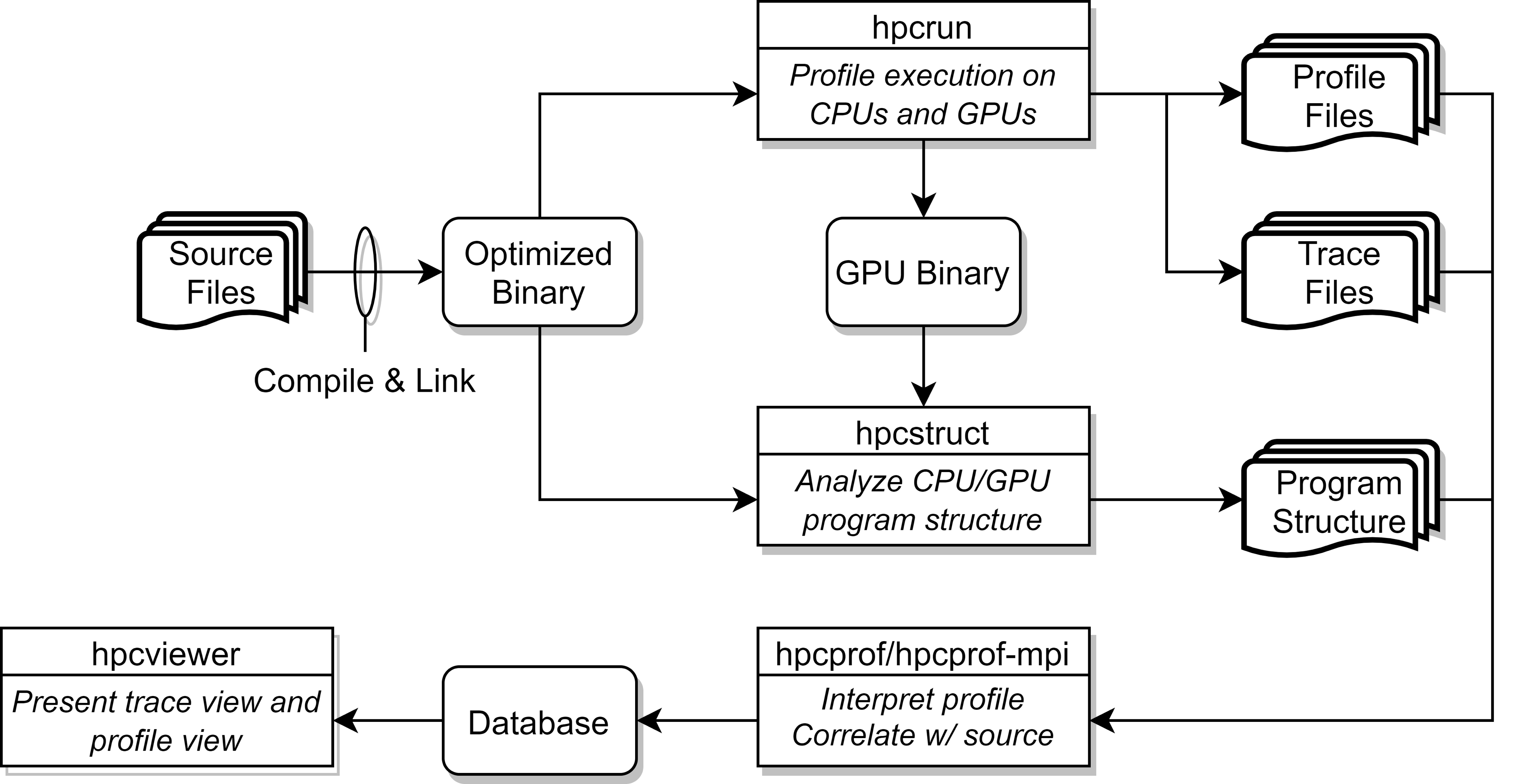
The figure below illustrates HPCToolkit's primary components and their relationships.
hpcrun: hpcrun collects accurate and precise calling-context-sensitive performance measurements for unmodified fully optimized applications at very low overhead (1-5%). It uses asynchronous sampling triggered by system timers and performance monitoring unit events to drive collection of call path profiles and optionally traces.
hpcstruct: To associate calling-context-sensitive measurements with source code structure, hpcstruct analyzes fully optimized application binaries and recovers information about their relationship to source code. In particular, hpcstruct relates object code to source code files, procedures, loop nests, and identifies inlined code.
hpcprof: hpcprof overlays call path profiles and traces with program structure computed by hpcstruct and correlates the result with source code. hpcprof-mpi handles thousands of profiles from a parallel execution by performing this correlation in parallel. hpcprof and hpcprof-mpi generate a performance database that can be explored using the hpcviewer user interface.
hpcviewer: hpcviewer is a graphical user interface that interactively presents performance data in three complementary code-centric views (top-down, bottom-up, and flat), as well as a graphical view that enables one to assess performance variability across threads and processes. hpcviewer is designed to facilitate rapid top-down analysis using derived metrics that highlight scalability losses and inefficiency rather than focusing exclusively on program hot spots.
hpcviewer also presents a hierarhical, time-centric view of a program execution. The tool can rapidly render graphical views of trace lines for thousands of processors for an execution tens of minutes long even a laptop. hpcviewer's hierarchical graphical presentation is quite different than that of other tools - it renders execution traces at multiple levels of abstraction by showing activity over time at different call stack depths.
 HPCToolkit is part of the ECP
which is a collaborative effort of two US Department of Energy (DOE) organizations - the Office of Science (DOE-SC) and the National Nuclear Security Administration (NNSA).
HPCToolkit is part of the ECP
which is a collaborative effort of two US Department of Energy (DOE) organizations - the Office of Science (DOE-SC) and the National Nuclear Security Administration (NNSA).
In this project, the goal is to extend HPCToolkit with improved capabilities for measurement and analysis of computation, data movement, communication, and I/O at extreme scale. Planned enhancements include improved support for lightweight measurement of massive node-level parallelism using hardware counters, measuring OS activity, recording measurement data efficiently, analyzing performance data in parallel, and integrating code-centric, time-centric, data-centric, and resource-centric views for analysis.
HPCToolkit is released under the 3-clause BSD license and is available on GitLab/HPCToolkit.
[Page last updated: 2022/10/11]